

 English
 中文简体



Home · News · Industry News · Which Sewage Pump Type Fits Your Wastewater Duty?
Industry News
Which Sewage Pump Type Fits Your Wastewater Duty?
2026-11-13Wastewater duties differ long before the water reaches the pump. A building collection system may receive domestic wastewater, while a production facility may discharge a changing mixture of water, fibres and process residues. Choosing a sewage pump therefore starts with the nature of the liquid and the job it must perform.
Shanying's sewage pump range includes stainless steel submersible models and cutting-type products. These offer different directions for wastewater projects. Understanding the distinction helps buyers discuss product suitability without assuming that a larger motor or a cutting mechanism automatically makes one pump appropriate for every site.
Start with the wastewater, then identify the product type
For building drainage, the selection brief should identify the source of the wastewater and what it normally contains. Water from a collection area, domestic wastewater and discharge from a commercial process can place different demands on the flow passages and materials. Even systems in similar buildings may need different pump configurations.
Industrial wastewater requires a closer description. Temperature, chemistry and abrasive particles can influence suitability alongside the visible solid content. A stainless steel product name alone does not establish chemical compatibility, and an attractive exterior does not reveal the material of every component in contact with the liquid.
Separate normal operating conditions from occasional contamination. That distinction helps the supplier assess whether the pump is being asked to handle an expected duty or compensate for an uncontrolled upstream process. It also supports a more realistic discussion of operating limits.
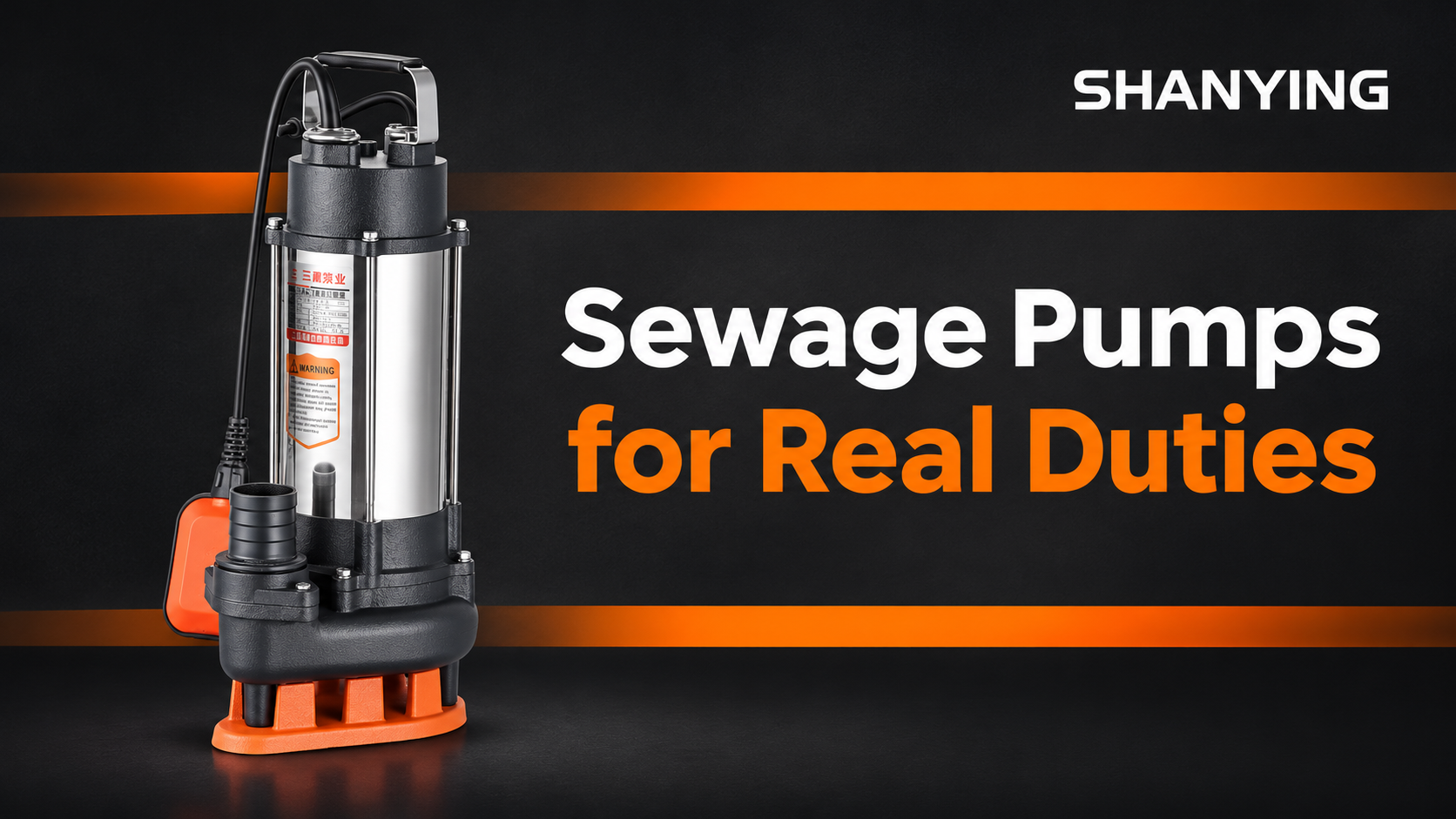
Stainless steel submersible sewage pumps: wastewater transfer
The V2200F-S stainless steel submersible sewage pump is one product reference in Shanying's range. This product category combines submerged operation with a construction intended for sewage transfer. Building drainage and wastewater collection projects can use it as a starting point for a model-specific review.
The important feature is the complete wastewater-handling design. The inlet, impeller and flow passages must suit the material carried in the liquid. Buyers should request the allowable solids information for the offered version and relate it to the actual application. Outlet diameter is not, by itself, an allowable particle-size rating.
For a project with a known wastewater composition, this approach makes the selection concrete: define what enters the collection system, then establish which product can transport it at the required duty. Material grade, seal construction and any control equipment should be included in the confirmed scope.
Cutting-type pumps: a different way to address suitable fibrous waste
A V1100-S cutting type submersible pump adds a cutting arrangement to the wastewater pumping function. That makes cutting-type products relevant when the application includes suitable fibres or flexible material that needs specific assessment.
The product distinction is useful, but the limits matter. Hard objects and abrasive grit create different problems from flexible fibres. Buyers should describe the material and ask the supplier which conditions the selected cutting arrangement is intended to handle. The presence of a cutter should not be presented as a guarantee of blockage-free operation.
Cutting capability also does not replace hydraulic selection. A pump may have an appropriate cutting design yet provide insufficient flow at the required head. Both the wastewater-handling function and the delivery requirement need to fit the same project.
A practical comparison for the purchasing team
| Project condition | Product direction to assess | Key confirmation |
|---|---|---|
| Building wastewater collection | Submersible sewage pump | Liquid composition and permitted solids |
| Suitable fibrous wastewater | Cutting-type submersible pump | Cutter suitability and material limits |
| Chemically demanding wastewater | Material-specific sewage pump selection | Compatibility of all relevant wetted components |
| High transfer volume | Hydraulic model with suitable capacity | Flow at actual total head |
This comparison is a route into product selection. It does not approve any model for a particular wastewater stream. A project may combine several conditions, such as fibres and chemical exposure, requiring the supplier to assess them together rather than select from one row alone.
Model differences should answer a project requirement
Models within a sewage pump range may differ in capacity, head, outlet and construction. A higher nominal output is useful only if it supports the required duty. Buying a larger model without reviewing the system can move the operating point away from the intended range instead of improving the result.
The selection should account for the elevation to the receiving point and losses through the pipework. Where wastewater inflow varies, establish the expected operating pattern as well as the peak condition. These details help the project team evaluate the pump curve and the proposed control arrangement.
For repeat procurement, retain the exact configuration rather than the family name alone. A familiar series label may cover several versions. The approved model, materials and supporting documents give the next order a clear reference.
Turn application information into a useful enquiry
- State whether the duty involves domestic, commercial or process wastewater.
- Describe solids, fibres, abrasive particles and relevant liquid chemistry.
- Provide the required flow and total head.
- Identify the operating pattern and any variation in inflow.
- Request a specific model, applicable curve and confirmed material configuration.
The benefit of a broad sewage pump range is the ability to discuss different product solutions for different wastewater duties. A submersible sewage pump and a cutting-type unit should each be considered for the work they are intended to perform. Bringing Shanying a clear application brief makes that comparison more useful than choosing by motor size, appearance or a single headline feature.
Contact Us
Your email address will not be published. Required field are marked*


- Tel: +86-0576-89933666
- Mob: +86-18608118888
- FAX: +86-0576-89933668
- Email: [email protected]
- Add: Building 13, Zeguo Electronmechaical Entrepreneurship Park, Wenling City, Zhejiang Province, China
Please contact us and look forward to happy cooperation with you.
Copyright © Taizhou Shanying Pump Co., Ltd. All Rights Reserved.
 China Pump Supplier

