

 English
 中文简体



Home · News · Industry News · How Can Solar Water Pumps Serve Farm Water Storage and Irrigation?
Industry News
How Can Solar Water Pumps Serve Farm Water Storage and Irrigation?
2026-11-27A farm water project has two connected tasks: obtaining enough water and delivering it when the crop or operation needs it. Solar pumping can contribute to that plan where sunlight, water-source capacity and the selected pump are suitable. Its value becomes clearer when the discussion begins with the farm's daily water requirement.
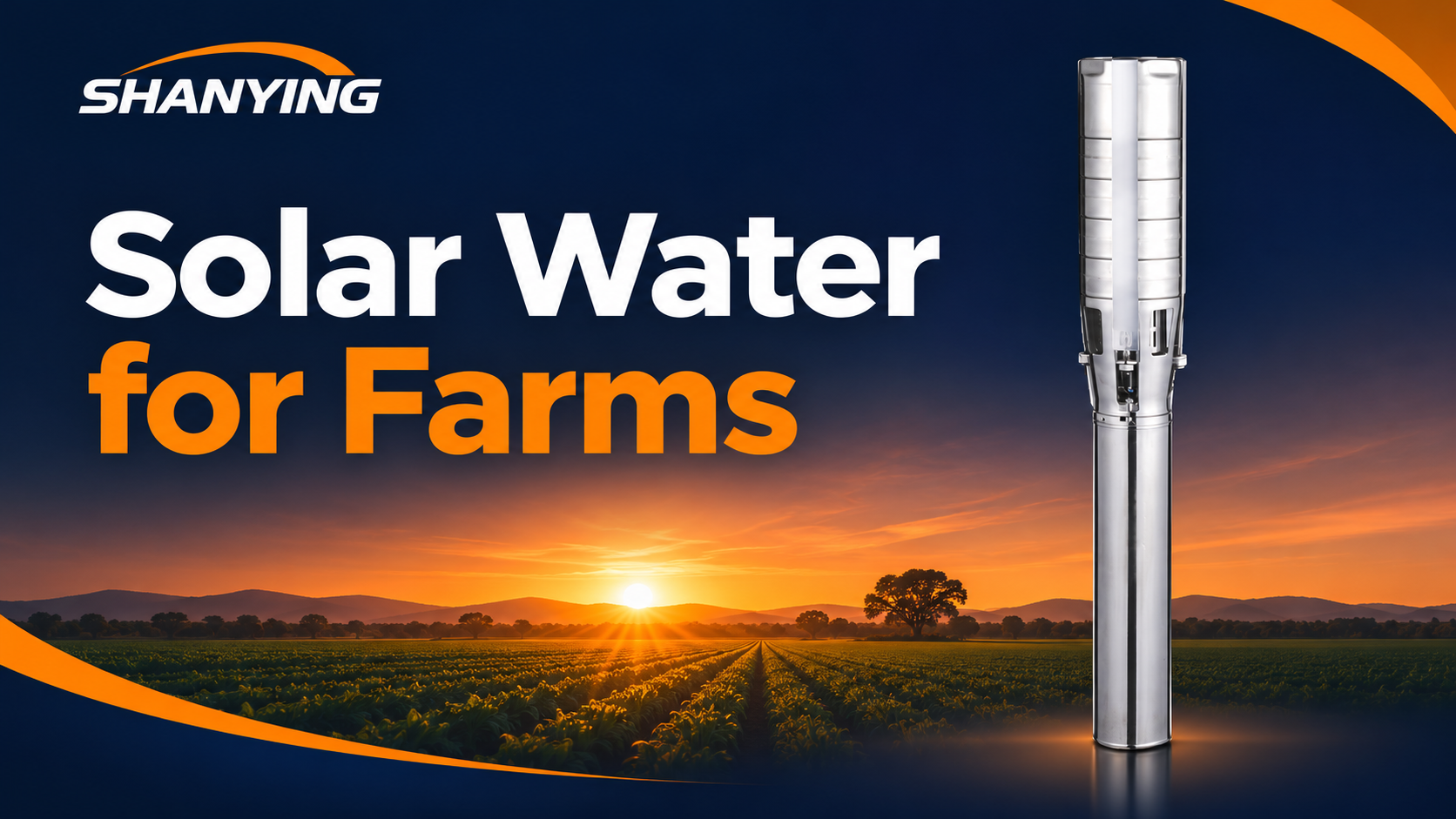
Shanying's 4PSS/6PSS stainless steel impeller solar irrigation pump range offers a product reference for this approach. The range provides different hydraulic and electrical configurations for assessment. Rather than treating every farm as the same application, buyers can use the daily water target, source conditions and delivery requirement to identify a suitable model.
Follow the water from source to use
A solar submersible pump may move water from a suitable well to a storage tank or delivery system. In a storage-based arrangement, pumping takes place when solar conditions allow, while the stored water supports later use. The tank helps separate the time of pumping from the time of consumption.
That separation can be useful when irrigation is scheduled outside the strongest sunlight hours. It does not make the water supply unlimited. Storage volume, daily demand and the amount the pump can actually deliver must be considered together, including periods of lower solar availability.
Direct delivery is another arrangement to assess. If the pump supplies an irrigation network while it operates, the required pressure and flow at that network become central. A system that only fills a tank may have a different hydraulic requirement from one feeding pressure-dependent irrigation equipment.
What the 4PSS/6PSS product range contributes
The 4PSS/6PSS stainless steel impeller solar irrigation pump gives buyers a range of model configurations to compare. Stainless steel impeller construction is a defining product feature. Its suitability still depends on the actual water conditions and the complete supplied specification.
Different versions address different flow, head and electrical requirements. This matters because a well with a substantial pumping lift presents a different duty from a source delivering to a nearby low-level tank. Choosing by the family name or the largest motor rating overlooks that distinction.
The exact power arrangement also needs to match the order. Pure solar operation and an approved hybrid arrangement are different configurations. Where backup supply is required, ask for a model and controller specifically documented for that purpose; do not assume that every product in the range accepts an alternative electrical source.
Build the plan around daily water volume
Instantaneous flow is useful, but farm planning also needs a daily volume. The water delivered across the available operating period must support irrigation, storage replenishment and any other intended use. Solar conditions change, so a single maximum-flow value cannot establish daily production.
As an arithmetic example only, a target of 20 cubic metres delivered over five effective pumping hours would require an average of four cubic metres per hour during that period. This is not a forecast for a Shanying model. Actual delivery needs a site-specific assessment using the pump performance, solar resource and system head.
Include the seasonal pattern as well. The period with the highest irrigation demand may have different water levels or operating conditions from the period when the equipment is first assessed. A useful selection brief describes the demanding season, not only an average day.
Compare the farm's possible water arrangements
| Arrangement | Main application benefit | Design focus |
|---|---|---|
| Well to storage tank | Stores water for later use | Daily delivery, lift and storage capacity |
| Well to irrigation network | Supplies water during pump operation | Required network pressure and variable solar input |
| Storage with separate distribution | Separates extraction from delivery timing | Water balance and downstream supply method |
| Approved hybrid pumping system | Adds a documented backup power option | Compatible model, controller and source arrangement |
These are planning options, not a list of standard accessories included with every pump. The project scope should identify which equipment is supplied by the pump manufacturer and which belongs to the wider water system.
The water source must support the pumping plan
A well's total depth does not by itself define the pumping lift. The water level during pumping, delivery elevation and pipe losses shape the duty the pump must meet. If the water level falls during operation or changes seasonally, those conditions should be included in the hydraulic review.
The source must also replenish at a suitable rate. Selecting a pump with greater capacity does not increase the well's sustainable yield. Establish the available water quantity and the required operating limits before choosing a model for a demanding daily target.
Water quality belongs in the same discussion. Stainless steel impellers should not be described as immune to sand wear or suitable for every chemical condition. Describe the suspended particles and relevant water characteristics so that the supplier can assess the proposed construction.
Connect the solar package to the selected pump
The panel array, controller and pump need to work as a compatible package. Panel wattage alone does not settle the electrical design. The applicable voltage range and controller requirements must be checked for the exact model and local conditions by the responsible system designer.
- Daily and seasonal water demand.
- Water-source yield and pumping water level.
- Delivery elevation, pipe route and required outlet pressure.
- Available solar resource and intended pumping period.
- Storage arrangement and any documented backup supply requirement.
A well-defined farm project makes the product discussion more useful. Buyers can ask Shanying to assess a 4PSS/6PSS configuration against the water target and operating conditions, supported by the relevant curve and electrical specification. That connects solar pump features to a practical agricultural outcome: moving water into a supply plan that reflects how the farm actually uses it.
Contact Us
Your email address will not be published. Required field are marked*

- Tel: +86-0576-89933666
- Mob: +86-18608118888
- FAX: +86-0576-89933668
- Email: [email protected]
- Add: Building 13, Zeguo Electronmechaical Entrepreneurship Park, Wenling City, Zhejiang Province, China
Please contact us and look forward to happy cooperation with you.
Copyright © Taizhou Shanying Pump Co., Ltd. All Rights Reserved.
 China Pump Supplier

