

 English
 中文简体
中文简体


Home · News · Industry News · How Does a 24 Volt DC Booster Pump Improve Water Pressure
Industry News
How Does a 24 Volt DC Booster Pump Improve Water Pressure
2026-09-04Water pressure is not determined by the water source alone. Once water enters a pipe network, the distance it travels, changes in direction, outlet demand, and restrictions along the line can all affect the pressure available at the point of use.
A storage tank, for example, may contain enough water for normal operation, yet an outlet farther away can still have weak flow. The same situation can occur in compact mobile systems where several components are connected along one water line. A booster pump is often introduced when the existing pressure is not enough for the intended use.
A 24 Volt DC Booster Pump works with a direct-current power supply and is commonly considered where a low-voltage electrical arrangement is already available. Its actual performance, however, depends on more than the motor and pump mechanism. The water source, pipe layout, electrical supply, control method, and outlet demand all have a part in the result.
Looking at those factors together gives a more useful picture of how water pressure can be improved and why performance may change after installation.
What Role Does a 24 Volt DC Booster Pump Play in a Water System
A booster pump sits within the water path and provides additional energy to the water as it passes through the pumping mechanism. In a typical arrangement, water comes from a tank or another source, enters the pump through the inlet, and then continues through the outlet piping toward the point of use.
The purpose is fairly specific: to help the water move through a system when the pressure available from the source is not enough.
That does not mean a pump can compensate for every problem in a water line. If the source cannot supply water freely, the inlet is restricted, or there is a leak somewhere downstream, adding a pump may not produce the expected result.
Consider a system with several outlets. Opening one outlet creates a different demand from opening several at the same time. The pressure available at each point can change accordingly. A booster pump can help maintain water movement, but its behavior remains tied to the conditions around it.
Several parts of the system are therefore worth considering together:
- The water source and its available supply
- The condition of the inlet line
- The arrangement of the outlet piping
- The amount of water being used
- The electrical supply
- The method used to control pump operation
This wider view also helps when diagnosing pressure problems later.
How Does a 24 Volt DC Booster Pump Increase Water Pressure
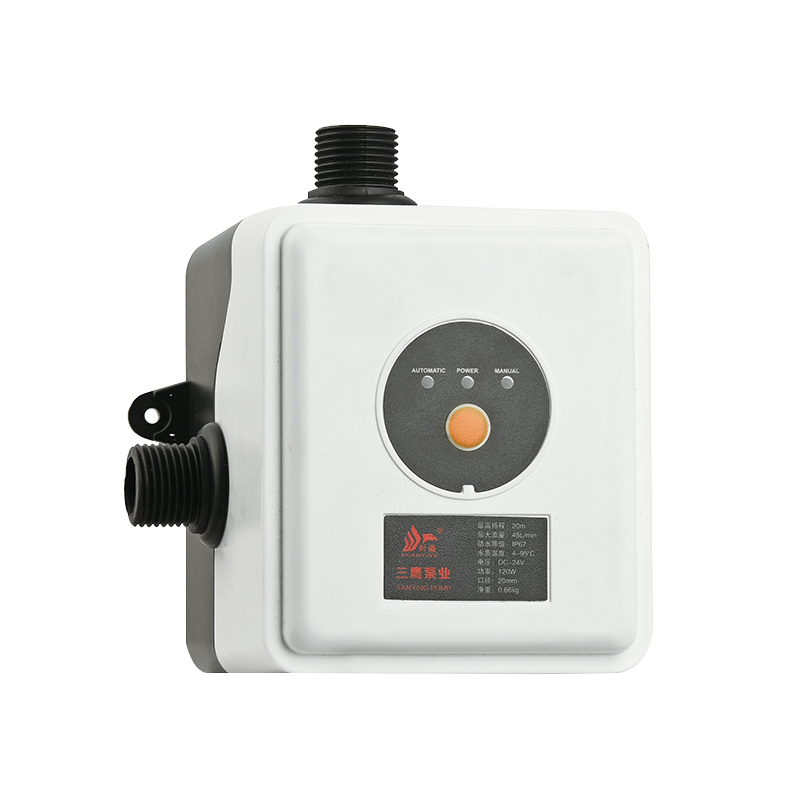
The motor supplies energy to the pumping mechanism, which in turn moves water from the inlet toward the outlet. As water passes through the pump, energy is transferred to the flow. That helps the water overcome resistance in the downstream system.
The process can be represented simply:
Water source → inlet → pump → outlet → point of use
It looks straightforward, but each section of the path can change the final pressure.
Suppose the outlet pipe is long and restrictive. The pump may be running normally, while the pressure at the far end remains lower than expected. A similar situation can occur when the inlet cannot provide enough water. The pump cannot deliver what is not reaching it in the first place.
Flow and pressure are also connected. When water demand changes, the operating point of the system changes with it. Opening a larger outlet creates a different condition from opening a smaller one.
The electrical side should not be overlooked either. A DC motor depends on a suitable power supply. Poor connections, an unsuitable supply, or excessive voltage loss along the wiring can affect motor operation.
So, when a 24 Volt DC Booster Pump appears to be producing less pressure than expected, the pump itself is only one part of the investigation.
Which Flow and Pressure Ratings Matter for a 24 Volt DC Booster Pump
Flow and pressure are often mentioned together, but they answer different questions.
Pressure indicates the ability of the pump to move water against resistance. Flow describes how much water can actually pass through the system. Looking at one without the other can give an incomplete picture.
A system that needs water at a distant outlet may require more pumping pressure than a short, open line. On the other hand, a system serving several outlets may place greater emphasis on maintaining adequate flow as demand changes.
The practical questions are fairly simple:
- How much water is needed at the outlet?
- How much resistance exists in the piping?
- Is the water moving upward?
- How far does it have to travel?
- Are several outlets likely to operate together?
The relationship between these conditions matters when reading pump specifications.
| System condition | Why it matters |
|---|---|
| Water demand | Determines the required flow |
| Pipe resistance | Affects the pressure available at the outlet |
| Vertical movement | Requires additional pumping effort |
| Inlet condition | Influences how much water reaches the pump |
| Outlet restriction | Can reduce delivered flow |
| Electrical supply | Affects motor operation |
A pump specification should therefore be viewed in the context of the intended water system. The number printed on a specification sheet does not necessarily represent the same operating condition that will exist after installation.
How Does Pipe Size Affect 24 Volt DC Booster Pump Performance
The pump and the pipe network work as one system. A suitable pump connected to poorly matched piping can still produce disappointing results.
The inlet deserves particular attention. If the path leading to the pump is restricted, water may not enter freely. A blocked passage, unsuitable connection, or unnecessary restriction can reduce the amount of water available to the pump.
Downstream piping creates another set of conditions. Long runs, multiple turns, and restrictive passages increase resistance. By the time water reaches the outlet, the pressure may be noticeably different from the pressure close to the pump.
Pipe leakage can create another complication. A small leak may cause pressure to fall even though the pump itself appears to operate normally.
Air in the line can also produce irregular flow. The symptoms may include pulsing water, inconsistent outlet performance, or a pump that behaves differently as the system runs.
When checking a piping arrangement, it is useful to work through the water path rather than inspect isolated components. Start at the source, follow the inlet, examine the pump connections, and then continue through the outlet line.
That approach makes it easier to identify whether the restriction is before the pump, inside the pumping system, or farther downstream.
How Does Automatic Control Work With a 24 Volt DC Booster Pump
A pump does not always need to run continuously. In many water systems, demand changes throughout the day, so the pump may need to start when water is required and stop when demand ends.
Automatic control can respond to changes in the water line. Depending on the arrangement, a pressure-based control responds to pressure changes, while a flow-based control responds to water movement.
Imagine a faucet connected to the system. When the faucet is opened, the water path changes and the control system detects that change. The pump starts or continues operating to support the new demand. When the faucet is closed, the operating condition changes again.
Problems can occur when the system repeatedly starts and stops without a clear change in water use. A small leak, an unsuitable control arrangement, or unstable pressure can create this kind of cycling.
The control method should therefore match the way water is actually being consumed. A system with intermittent demand has different operating requirements from one where water flows continuously.
Why Can a 24 Volt DC Booster Pump Lose Water Pressure
Low pressure can have several causes, and replacing the pump is not always the appropriate response.
The water source is a reasonable place to start. If there is not enough water available at the inlet, the pump cannot maintain normal output. After that, the inlet piping, connections, and downstream line can be checked for restrictions or leaks.
Electrical conditions are another consideration. A loose connection or an unsuitable power supply can change motor behavior. In some cases, the pump may start normally but fail to maintain the expected operating condition once the load changes.
A practical troubleshooting sequence can follow the water and power paths separately:
- Check whether water is reaching the inlet properly.
- Inspect the inlet for blockage or restriction.
- Check connections for leakage or air entry.
- Examine the outlet piping and fittings.
- Check the electrical connections and power supply.
- Observe whether the control system is starting and stopping normally.
The timing of the pressure change can provide useful clues. A sudden change may point toward a blockage, connection problem, or electrical interruption. A gradual decline may be associated with leakage, buildup, wear, or changing system conditions.
This type of step-by-step inspection can prevent a system problem from being mistaken for a pump failure.
How Does a 24 Volt DC Booster Pump Fit Different Water Systems
A booster pump can be used in several types of water arrangements, but the surrounding requirements are not identical.
A storage-tank system may need additional pressure between the tank and the outlets. In a mobile water system, the available space and DC power source can influence the installation. A filtration system may create additional resistance that the pump has to overcome.
Off-grid installations introduce another consideration: the pump and the available electrical source have to work together. The water side and electrical side cannot be planned independently.
Different outlet arrangements also change how the pump operates. A single outlet with occasional use places different demands on the system than several outlets being opened at the same time.
| Water system | Main point to consider |
|---|---|
| Storage tank | Available water at the source |
| Mobile water setup | Piping arrangement and power supply |
| Filtration setup | Resistance created by the filtration path |
| Off-grid system | Compatibility with the available DC supply |
| Multiple outlets | Changes in water demand |
The installation environment matters as well. Available space, pipe routing, access for maintenance, and protection from unsuitable operating conditions can all influence where the pump should be placed.
Rather than treating the pump as a standalone component, it is more useful to consider how it fits into the particular water circuit.
How Can You Select a 24 Volt DC Booster Pump for a Water System
Selection should begin with the requirements of the water system. The pump comes afterward.
Start by considering the pressure needed at the point of use and the amount of water that needs to pass through the line. Then look at the piping arrangement, including the distance between the water source and outlet and any sections that may create resistance.
The electrical arrangement needs the same attention. A DC pump requires a compatible power source, suitable connections, and wiring capable of supporting normal operation.
The control method is another part of the decision. Manual operation may suit a straightforward setup, while an automatic arrangement can make more sense where water demand changes frequently.
A useful selection checklist includes:
| Selection factor | Question to consider |
|---|---|
| Water demand | How much flow is required? |
| Pressure | What pressure is needed at the outlet? |
| Piping | Does the existing pipe arrangement create significant resistance? |
| Water source | Can enough water reach the pump inlet? |
| Power source | Is the DC supply suitable for the pump? |
| Control | Should operation be manual or automatic? |
| Installation | Does the available space suit the pump and connections? |
There is no single specification that determines whether a pump will work well in every installation. Pressure, flow, piping, water supply, electrical conditions, and control all interact.
A 24 Volt DC Booster Pump is therefore best evaluated as part of the complete water system. When the pump capacity and the surrounding conditions are considered together, the expected pressure and flow are easier to assess before installation.
Contact Us
Your email address will not be published. Required field are marked*


- Tel: +86-0576-89933666
- Mob: +86-18608118888
- FAX: +86-0576-89933668
- Email: [email protected]
- Add: Building 13, Zeguo Electronmechaical Entrepreneurship Park, Wenling City, Zhejiang Province, China
Please contact us and look forward to happy cooperation with you.
Copyright © Taizhou Shanying Pump Co., Ltd. All Rights Reserved.
 China Pump Supplier

